

The U.S. Department of Housing and Urban Development Continuum of Care (CoC) program is the largest federal funding source for homeless services. On Monday, June 1, HUD opened the funding competition for this program, including grants for the Youth Homelessness Demonstration Project.
Key elements of this year’s Notice of Funding Opportunity (NOFO):
- The FY2026 NOFO includes approximately $4.04 billion nationally for nonprofits, local governments, states, and tribes working to address homelessness.
- Up to $1.3 billion is set-aside for new projects, with a priority for Transitional Housing (TH) or Supportive Services Only (SSO) projects, ranked in two tiers.
- Projects in Tier I are only required to meet minimum threshold requirements, are not subject to the overall CoC application score, and are relatively assured of receiving ongoing renewal funding.
- Tier II projects are awarded competitively. The current NOFO caps Tier I funding at 60% of a community’s annual renewal demand, compared to 90% in previous years.
- New Transitional Housing programs must require participants to engage in a minimum of 20 hours per week of services, activities, or employment. People over the age of 62, meet a definition of disabled, or who have a developmental disability will be exempt from service requirements.
- New SSO-Street Outreach projects must demonstrate partnership with law enforcement and/or first responders.
- An additional $104 million will be available for Domestic Violence Bonus grants, with Transitional Housing as an eligible project type.
Applications are due to HUD by Wednesday, August 26, 2026. Awards will be announced no later than December 1, 2026.
Nationally, almost 100,000 people may lose their housing because of the changes in the current NOFO
According to analysis by the National Alliance to End Homelessness and the Coalition on Homelessness and Housing in Ohio, the FY2026 NOFO represents a sharp departure from previous competitions, which prioritized permanent housing solutions to homelessness.
Through significant set-asides for new Transitional Housing and SSO projects, the current NOFO deprioritizes renewal funding for existing permanent housing projects. This places thousands of households at risk of losing their homes.
Capping Tier I funding at 60% compared to 90% under previous competitions, puts significantly more funding at competitive risk.
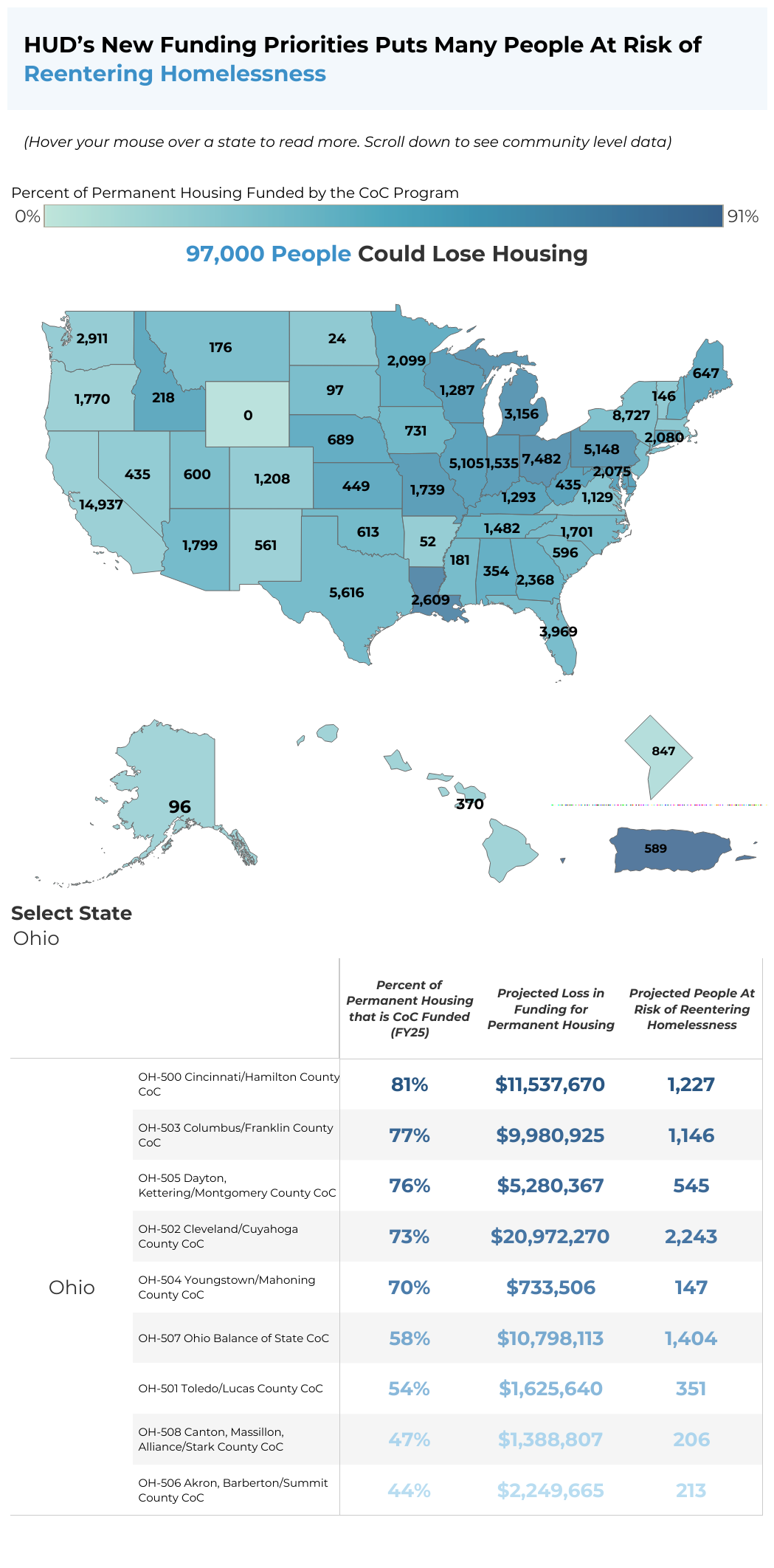
As a result of these changes, the National Alliance estimates that at least 97,000 people in CoC-funded permanent housing across the country will lose their housing. The analysis breaks this impact down by state and individual CoC:
FY26 NOFO Impact Analysis | Tableau Public
More than 7,000 Ohioans could lose their homes under new HUD NOFO changes
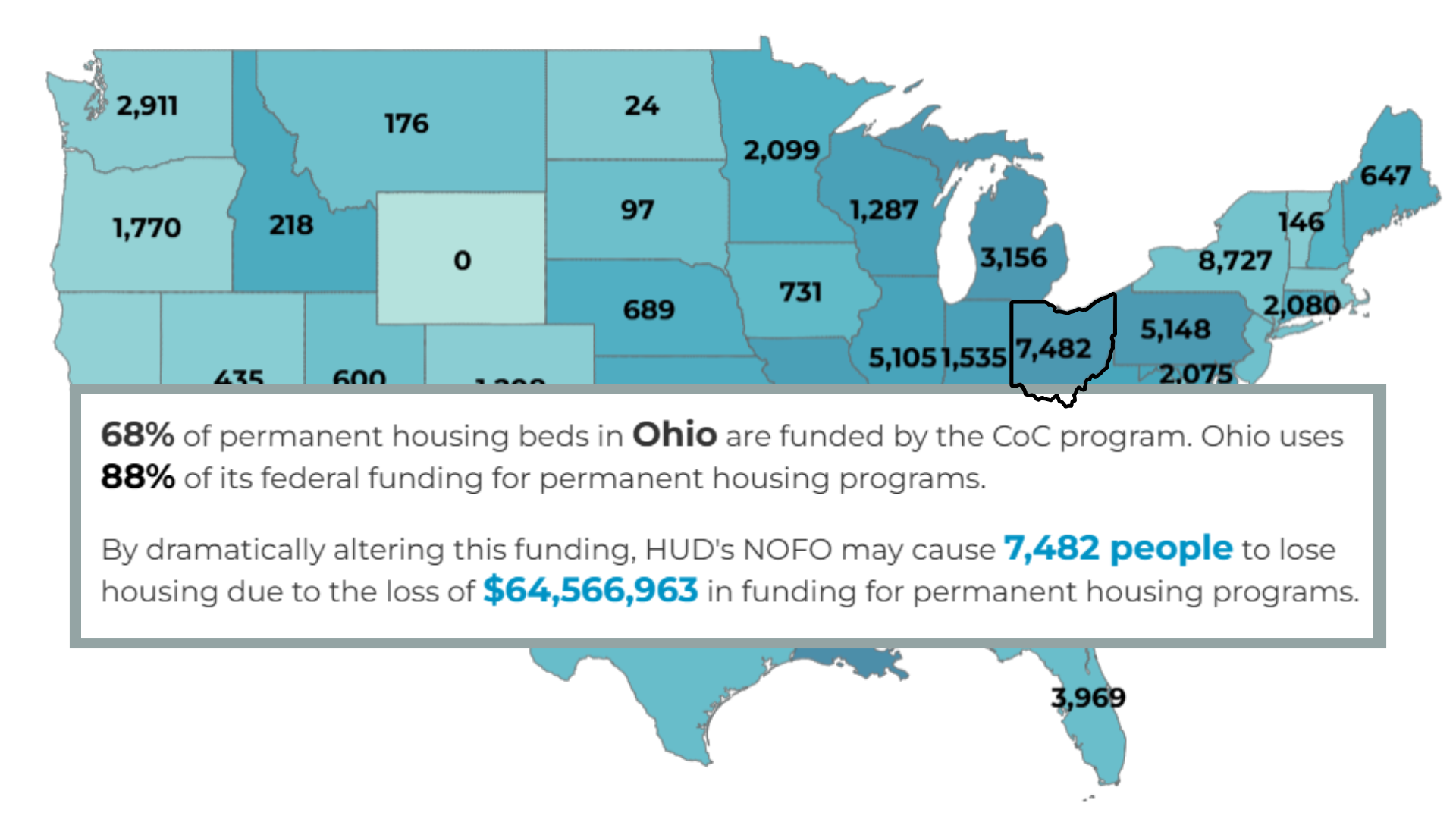
States like Ohio that rely on the CoC program to fund permanent housing for homeless and formerly homeless households are at greatest risk of losing dollars and units. According to the National Alliance analysis, Ohio communities are at risk of losing a total of $64.6 million in CoC resources, and more than 7,400 people may lose their housing as a result of the changes in the current NOFO.
After the 90-day NOFO competition period and HUD’s internal review, funding awards are expected to be announced by December 2026. After new grant contracts are executed in 2027, projects impacted by funding changes will have a year to transition and/or terminate. The impact of these changes will likely not be felt until 2028. Community partnerships will be critical to support affected households.




.png)